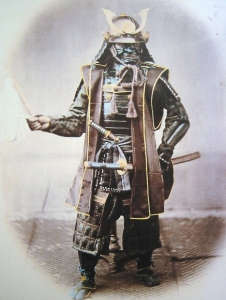
Bushido (武士道; ) literally meaning “the way (manner) of the warrior”, is a Japanese word referring to the samurai way of life, which can be compared to that of the European Knights.
The term “Bushido” is modern and not often found in the past. The “way” itself comes from the moral values of the samurai and most commonly refers to some combination of austerity, loyalty, knowledge of martial arts and the concept of honor until death. Originating from the Neo-Confucianism of the peaceful Tokugawa period and based on Confucian texts, Bushido was also influenced by Shinto and Zen Buddhism, leading to the moderation of samurai violence by wisdom and serenity. Many scholars place the development of Bushido between the 16th and 20th centuries and base it on an earlier legacy from the 10th century, although some scholars have noted that the term Bushido “is rarely found in later literature”.
Under the Tokugawa Shogunate, aspects of warrior values were formally incorporated into Japanese feudal law.
The word was first used in Japan during the 17th century. It came into widespread use in Japan and the West after the publication in 1899 of “Bushido: The Soul of Japan” by Nitobe Inazo.
In “Bushido” (1899), Nitobe wrote:
“… Bushido, therefore, is the code of moral principles that samurai were required or instructed to observe…. More often it is a silent and unwritten code…. It was an organic development of decades and centuries of military career. To become a samurai one must master this code.”
Doctrines
Bushido expanded and formalized the earlier samurai code, and emphasized austerity, loyalty, knowledge of martial arts, and honor unto death. According to the Bushido ideal, if a samurai failed to save his honor, he could regain it only by committing seppuku (ritual suicide).
In an excerpt from his book Samurai: The World of the Warrior, historian Stephen Turnbull describes the role of seppuku in feudal Japan:
“In the warrior world, seppuku was an admirable act of bravery for the samurai who had known defeat, disgrace, or was mortally wounded. It meant that he could end his days with his wrongdoings forgiven and his reputation not only intact but actually enhanced. Cutting the abdomen liberated the samurai’s spirit in the most dramatic way, but it was also an extremely painful and unpleasant way to die, and so the suicidal samurai sometimes asked a loyal companion to cut off his head in his moment of agony.”
Bushido also changed dramatically over time: over time, but also depending on the geographic and socio-economic background of the samurai, who constituted between 5% and 10% of Japan’s population. The first census of the Meiji period, in the late 19th century, estimated 1,282,000 members of the “high samurai” class, who were allowed to ride horses, and 492,000 members of the “low samurai” class, who were allowed to carry two swords but not ride horses, in a country of about 25 million.
Some versions of Bushido include the value of compassion for those of lower rank, as well as that of preserving one’s name. Early literature on Bushido further emphasizes the obligation to behave with calmness, equality, justice, and propriety. The relationship between learning and the way of the warrior is clearly defined: one is a natural complement to the other.
Other experts in the philosophy of the warrior refer to methods of raising children, appearance, and grooming, but all of these can be seen as part of a person’s ongoing preparation for death – a good death with honor intact, which is the ultimate goal in a life according to the Bushido code. Indeed, a “good death” is a reward in itself, and in no way guarantees “future rewards” in the afterlife.
Notable samurai, though certainly not all (e.g. Amakusa Shiro) have in the past challenged these beliefs, especially in relation to murder, and that this precludes such future afterlife rewards, especially in Buddhism.
In contrast, the soul of a noble warrior suffering in hell or some spirit remaining in the world of the living is a common motif in Japanese art and literature. Bushido, while showing Taoist influences through Zen Buddhism, is a philosophy that opposes religious beliefs, with a deep commitment to decency in this world.
Οι 7 αρετές του Bushido