
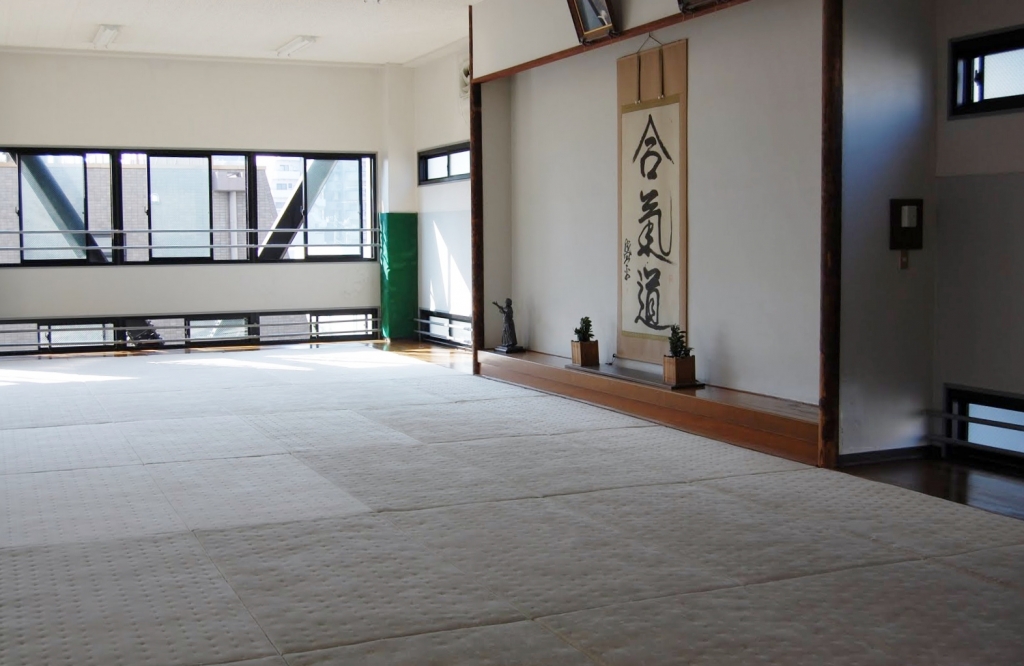
Aikikai is the original school of Aikido. Its center is the Aikikai Foundation in Japan with Doshu (the blood heir of the founder of Aikido) as its leading representative. At the global level, it is represented by the International Aikido Federation.
The Aikikai Aikido Style
Aikikai is not a homogeneous Aikido style, but instead encompasses a variety of techniques. This is due to the broad base of first-generation instructors, who each had their own interpretation of the art and different influences. Nevertheless, Aikikai is often described as a style to differentiate from other Aikido organizations. Aikikai is considered to be the most traditional, remaining true to the Ueshiba lineage, and is therefore sometimes called Ueshiba Aikido. It has retained many of the aspects valued by Morihei Ueshiba, such as the non-competitive training system (in contrast to the development of Tomiki). It also does not place as much emphasis on spiritual interpretations as in the Ki Society.
Morihei Ueshiba’s own style varied throughout his lifetime. The pre-war aikibudo techniques taught by Ueshiba were generally closer to aikijujutsu while the technique became more fluid as he grew older, a differentiation reflected in the aikido technique of people who studied at different time periods under him.
The Aikikai Aikido School
Within Japan, there are approximately 1800 training sites affiliated with the Hombu, united under the All-Japan Aikido Federation.
Abroad, there are approximately 100 Aikido organizations recognized by the Hombu. These are national Aikido organizations, each representing many dojos and many practitioners. The levels of practitioners in these organizations are set directly by the Hombu. (The Hombu has specific procedures for examinations and levels of the various grades as well as instructor titles, thus ensuring a degree of international consistency and serving to prevent local excesses by instructors.) However, regardless of recognition, all schools remain administratively independent of the Aikikai Foundation.
Students of recognized schools around the world are collectively referred to as the Aikikai school, although this “school” is not an official organization. Their technique may be referred to as the Aikikai style, although this covers a wider range than the newer styles of Aikido.
Hombu dojo
The Hombu in Tokyo is the headquarters of the Aikikai, considered the World Headquarters of Aikido and controlled solely by the Aikikai Foundation. It is sometimes called the Aikikai Hombu to distinguish it from the headquarters of later Aikido organizations. Hombu (本部 Honbu) is a common word meaning “headquarters”.
The Hombu dojo has about 30 instructors, most of whom are Shihan. Instructors include Doshu and Hiroshi Tada 9th dan. It is located in the Wakamatsu-cho area of Shinjuku, Tokyo, Japan. (The same location was formerly the Ushigome Ward of Shinjuku.)
It was founded in April 1931 by Ueshiba and was originally called Kobukan Dojo (皇武館道場, imperial martial hall), but was renamed “Hombu Dojo” after World War II.
In 1967, the original ground-floor wooden building was replaced by a modern 5-story building. Training takes place in 3 rooms with a space of approximately 250 tatami. The main training area is 105 tatami (170 m2). The other two rooms have 72 and 42 tatami respectively, and are often used for beginners’ classes, children’s classes, women’s classes, or for fixed-term enrollment and “academy” (Gakko) classes.
Classes are held seven days a week. These beginners’ and regular classes are open to all Aikido practitioners who are or become members of the Aikikai. A small number of practitioners reside at the Dojo as part of a private training program.